What Is a Working Pit Bulldog?
The Working Pit Bulldog is a breed classification created by the American Dog Breeders Association (ADBA) to recognize a type of dog that had been developing inside the American Pit Bull Terrier stud book for decades without a name of its own: a larger, heavier-boned, performance-bred bulldog selected generation after generation for one thing: pulling power.
These dogs did not appear out of nowhere. The Working Pit Bulldog descends from specific weight-pull performance lines, most notably Eddington's Wanna Be A Whopper and the Dagger bloodlines. Over roughly thirty years of weight-pull competition, breeders selecting strictly for performance on the pull track produced dogs that kept their American Pit Bull Terrier foundation but grew into something structurally distinct: taller, heavier, more bone, more rear-end power. The dogs were real and the results were real, but the paperwork still said APBT, and the label no longer fit the animal standing in front of you.
In 2015 the ADBA fixed the paperwork. Rather than pretending a 100-pound pull dog and a 45-pound heritage terrier were the same breed, the registry created the Working Pit Bulldog classification: an honest home for the performance lines, with its own standard, its own weight range, and its own registration.
The short version: a Working Pit Bulldog is an ADBA-registered dog from recognized weight-pull performance lineage, weighing 75–135 pounds lean, built and bred for work.
The 2015 ADBA Reclassification
For over a century, the ADBA has been the registry most closely associated with the American Pit Bull Terrier. Founded in 1909, its focus has always been the preservation of the breed's heritage, working ability, and correct structure, codified in the APBT Heritage Conformation Standard.
By the 2010s, the registry had a problem. The term "pit bull" had become a melting pot. Dogs registered as American Pit Bull Terriers were, in reality, several distinct types: heritage APBTs true to the original standard, show-line dogs matching the American Staffordshire Terrier, compact companion-bred dogs matching the American Bully, and the big performance-bred pull dogs. Registering all of them under one breed name protected no one and blurred every line.
Beginning in early 2015, the ADBA opened an investigation into its own APBT stud book. The registration department reviewed pedigree records, photographs submitted with registrations, and publicly available images of dogs produced by specific kennels and bloodlines, in order to understand what type of dog each line was actually producing. Registration with another kennel club under a different breed name also qualified a dog for reclassification.
The outcome was a set of stud book corrections that reshaped the registry:
- An ideal weight range of 30–75 pounds was added to the APBT Heritage Conformation Standard.
- The American Staffordshire Terrier was confirmed as a separate breed.
- The American Bully was recognized as a separate breed.
- The Working Pit Bulldog was established as a new breed classification for dogs from the weight-pull performance lines.
Dogs that had already earned performance points and titles with the ADBA retained them through reclassification. The record followed the dog. And critically, reclassification was applied to living dogs going forward: this was not an attempt to rewrite history, but to make sure every dog going forward was registered under the name that actually describes it.
Why It Mattered
Reclassification let the ADBA protect the historical integrity of the American Pit Bull Terrier while creating an honest place for breeders producing larger working bulldogs. Nobody had to shoehorn a 110-pound pull dog into a heritage terrier standard anymore, and nobody could hide a mislabeled dog behind an APBT registration. Accuracy served both breeds.
The ADBA Working Pit Bulldog Standard
The Working Pit Bulldog standard is built around soundness and function. The defining numbers:
- Weight: 75–135 pounds in lean condition. This is a lean weight: conditioned, not fat. A soft dog carrying slop weight is not what the range describes.
- Hard ceiling at 135. Any dog weighing over 135 pounds lean at two years of age cannot be registered. The registry drew this line deliberately: past a certain mass, structure and longevity break down, and the breed stops being a working animal.
- No extremes. Dogs with exaggerated conformation or structural health problems are excluded from registration. The standard exists to keep the breed functional, not to reward size for its own sake.
Beyond the numbers, the type reflects its purpose. A correct Working Pit Bulldog shows its American Pit Bull Terrier foundation while carrying the traits three decades of pull selection built into it:
- Larger overall size and heavier bone structure than the APBT
- Longer legs and a taller frame
- Strong, well-developed musculature over the whole dog
- A powerful rear assembly, the engine of a pull dog
- Stable temperament with zero tolerance for human aggression
That last point is non-negotiable across every ADBA breed. Human aggression is a disqualification, full stop. A dog that cannot be handled by strangers at a weigh-in, harnessed on a crowded track, and examined by officials is useless as a working animal regardless of what it can pull.
Working Pit Bulldog vs. American Pit Bull Terrier
The two breeds share foundation and history, which is exactly why the registry separated them. Proximity without distinction breeds confusion. Here is where they actually differ:
| American Pit Bull Terrier | Working Pit Bulldog | |
|---|---|---|
| Weight standard | 30–75 lbs ideal conditioned weight (ADBA Heritage standard) | 75–135 lbs lean; over 135 lbs lean at 2 years is not registrable |
| Frame | Medium-sized, square, agile all-around athlete | Taller, longer-legged, heavier bone, more mass |
| Lineage | Heritage APBT lines tracing to the original stud book | Weight-pull performance lines: Whopper, Dagger, and dogs descending from them |
| Selection pressure | Heritage type: balance of speed, power, agility, stamina | Roughly 30 years of selection for pulling performance |
| Registration | ADBA APBT stud book; also recognized by UKC | Separate ADBA breed classification created in the 2015 reclassification |
| Temperament | Human aggression disqualifies | Human aggression disqualifies |
A note on dual registration: many Working Pit Bulldogs also carry UKC American Pit Bull Terrier papers, because the UKC has not created an equivalent classification. That is why you will see dogs, including several in our program, listed as "ADBA Working Pit Bulldog · UKC American Pit Bull Terrier." The ADBA registration is the one that names the dog's actual type; the UKC registration is what allows the dog to compete for UKC titles like the UWP.
Neither breed is "better." A heritage APBT is a scalpel; a Working Pit Bulldog is a sledgehammer. They were selected for different jobs, and the registry finally gave each job its own name.
The Breed's Role in Weight Pull and Working Sports
Weight pull is not something the Working Pit Bulldog happens to be good at. Weight pull is the selection pressure that created the breed. For roughly three decades before the classification existed, breeders were making pairings based on what happened on the track: which dogs pulled, which dogs finished, which dogs wanted more. The Working Pit Bulldog is the accumulated result of those decisions.
In organized weight pull (ADBA-sanctioned pulls, UKC events, and IWPA competition), dogs pull a weighted cart or sled across a measured distance, competing within weight classes. The sport rewards exactly what the breed was built for:
- Rear-end power. The drive comes from behind. The breed's powerful rear assembly is not cosmetic. It is the drivetrain.
- Bone and frame. Heavy pulls load the whole skeleton. The breed's added bone is load-bearing infrastructure.
- Work drive. No dog can be forced to pull. The desire to lean into a harness and finish a pull is heritable, and it was selected for relentlessly.
- Handler focus. On the track it is one dog, one handler, and dead weight. Dogs that work with their handler under pressure win.
Beyond the pull track, the same traits transfer to other working sports and jobs: Top Dog athletic events, drag work, conditioning sports, and any task where controlled power matters. But weight pull remains the breed's home turf and its proving ground. A Working Pit Bulldog that has never been asked to work is an unfinished dog.
The Next Freak Program: Engineered, Not Bred
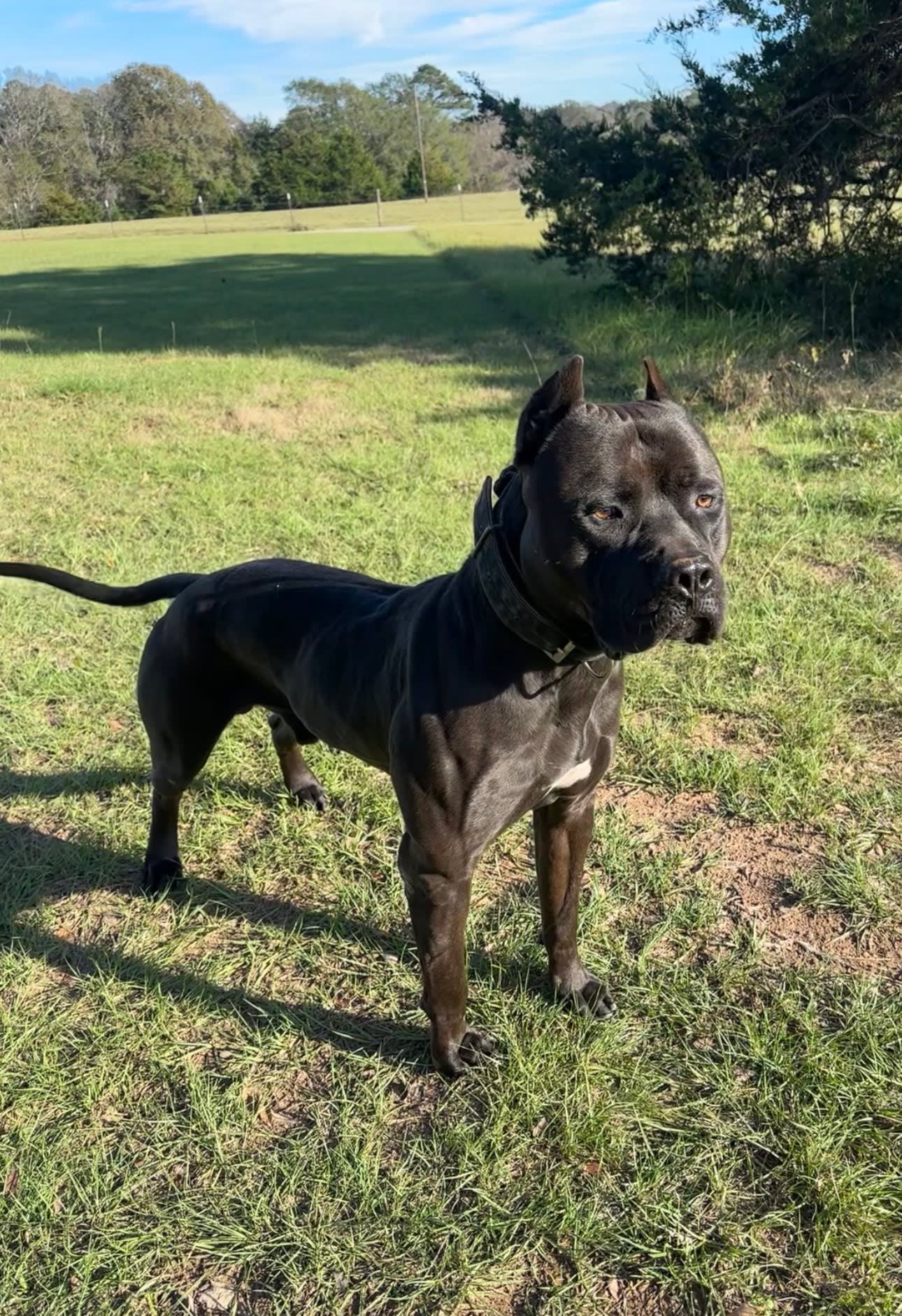
Next Freak is a Georgia performance kennel. We own ADBA-registered Working Pit Bulldogs carrying Whopper and Dagger blood, and we breed them under one methodology: Engineered, Not Bred. That phrase is not branding. It describes a set of gates every pairing has to pass:
- Embark health screening. Breeding stock is DNA-screened. We are not guessing about what a pairing carries.
- A COI ceiling. Every pairing is checked against a hard coefficient-of-inbreeding limit. Tight breeding without a ceiling is how lines collapse; we treat COI as an engineering constraint, not a suggestion.
- Competition titling as a breeding gate. Dogs earn their way into the whelping box on the track. Our competitors hold UWP titles through UKC and have taken first-place finishes in IWPA classes. Proof precedes production.
The Working Pit Bulldogs currently in the program include Wu-Tang, a stud bringing size, structure, and working bloodlines; Molly, the dam behind our current Cowboy pairing; and Venna, a quality female whose structure and working bloodlines strengthen what we are building. Puppies from our active pairings are registered as ADBA Working Pit Bulldogs and placed selectively: sport homes, working placements, and serious owners who understand what they are getting.
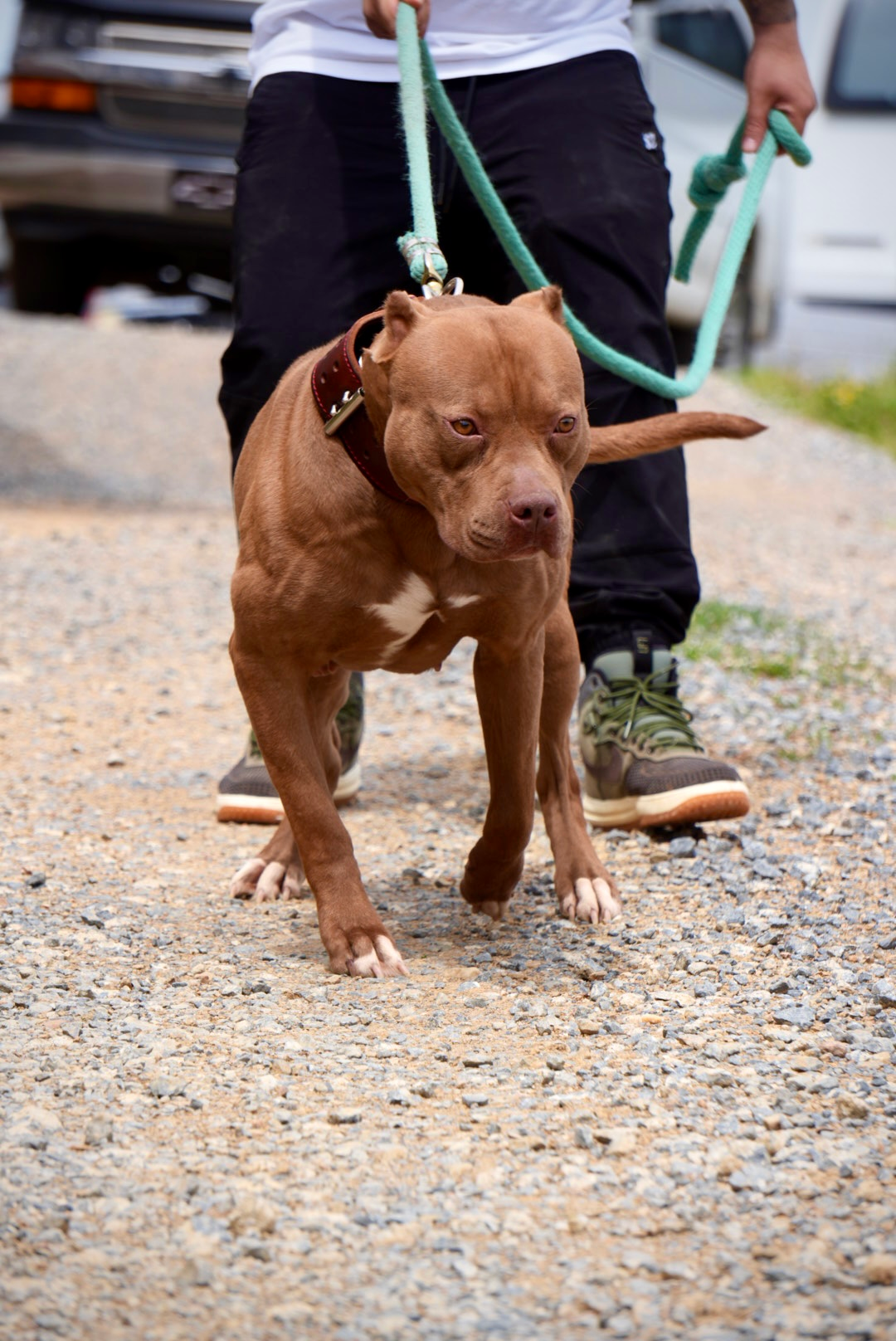
Every dog here that can work, does work: year-round conditioning, structured training, and honest evaluation. That is what separates a registered Working Pit Bulldog from a big dog with papers.
Frequently Asked Questions
What is a Working Pit Bulldog?
A breed classification created by the ADBA in its 2015 stud book reclassification, recognizing dogs from weight-pull performance lines, most notably Whopper and Dagger, that developed into a larger, heavier-boned type distinct from the American Pit Bull Terrier.
How big is a Working Pit Bulldog?
75–135 pounds in lean condition under the ADBA standard. A dog over 135 pounds lean at two years of age cannot be registered.
Is a Working Pit Bulldog the same as an American Pit Bull Terrier?
No. They share foundation, but the APBT Heritage standard runs 30–75 pounds while the Working Pit Bulldog runs 75–135 pounds lean, descends specifically from weight-pull performance lineage, and is registered as its own ADBA breed. Many Working Pit Bulldogs also hold UKC APBT papers because the UKC has no equivalent classification.
Is it spelled "pit bulldog" or "pitbull dog"?
Both point to the same dog. "Pit bulldog" is the ADBA's official breed name, but people searching often type "pitbull dog" or "working pitbull dog" as one word. Either spelling means the same thing: a large, heavy-boned dog descending from weight-pull performance lines and registered by the ADBA as its own breed, separate from the American Pit Bull Terrier.
Are Working Pit Bulldogs good family dogs?
A correctly bred Working Pit Bulldog is human-stable. Human aggression is a registration disqualification. But this is a powerful working breed that needs conditioning, structure, and a job. It belongs with owners prepared to work it, not with homes looking for a couch ornament.
Where can I get a registered Working Pit Bulldog?
From a breeder who can show you the dog's ADBA registration, its working lineage, health screening, and, most importantly, the parents actually working. Our current pairings and placement process are on the breedings page.
See the Dogs Behind This Page
The roster, active breedings, and placement application are on the main site. Serious inquiries only. Have your details ready.
The Dogs Current Breedings Waiting List